Photo is illustrative. Last updated 8 October 2026.
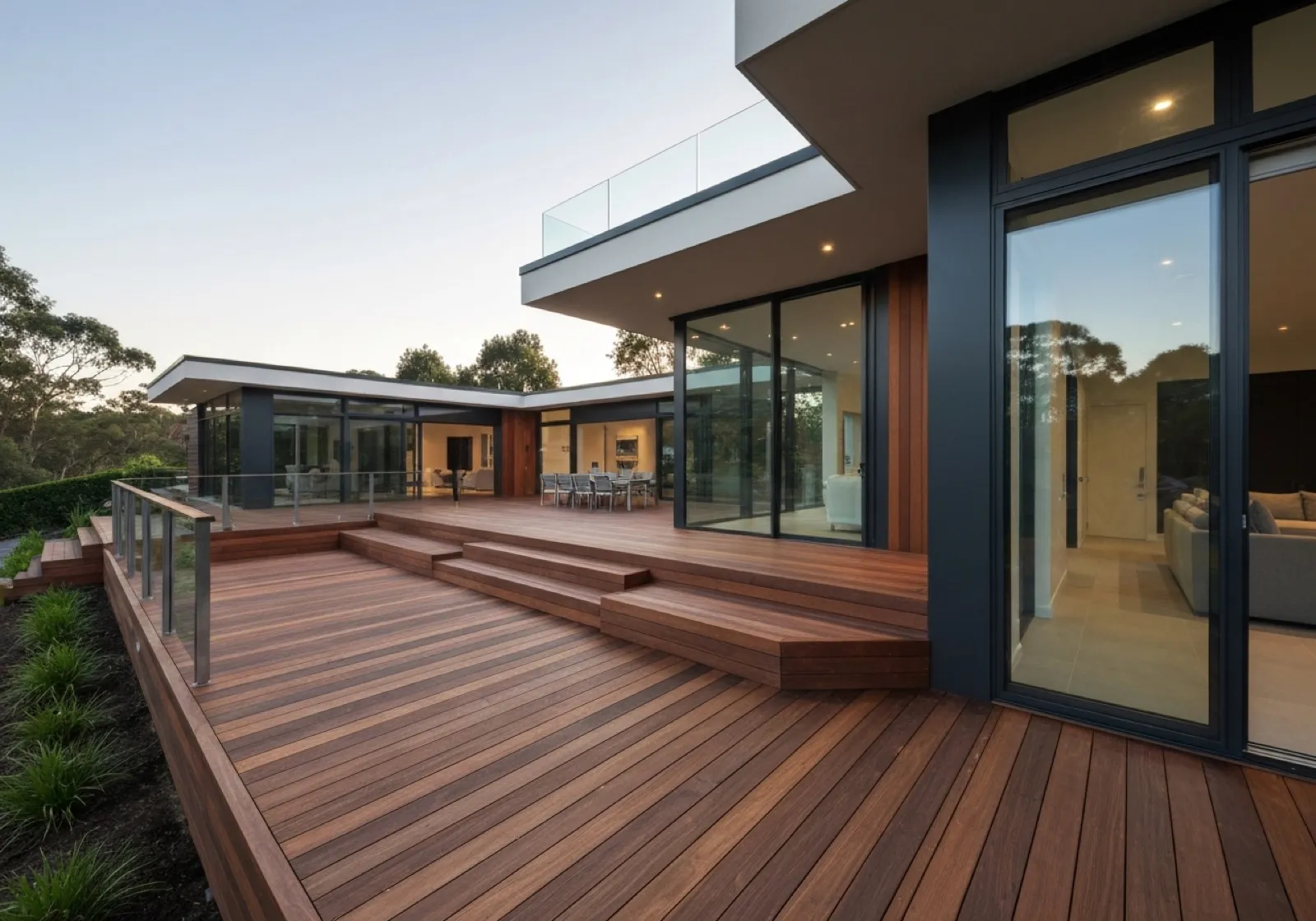
Timber decking in Adelaide has a warmth that’s hard to beat. Real hardwood boards each have their own grain and colour, and a well-built, well-oiled deck ages into the garden rather than standing apart from it. We design and build hardwood decks from our base in Brooklyn Park for homes across greater Adelaide.
Timber decking is one part of our wider decking service. This page covers the hardwood species we use, how timber behaves in Adelaide’s climate, and what to expect from the build.
Why choose hardwood decking?
Hardwood decking suits people who want a natural, authentic look and are comfortable with some ongoing care. It also has some practical advantages.
- Natural character. No two boards are the same, which suits character villas, bungalows and leafy gardens.
- Comfortable underfoot. Timber generally stays cooler than darker composite boards in full sun.
- Repairable. Scratches and wear can be sanded back and re-coated rather than replacing boards.
- Flexible finish. You can oil the deck to keep its colour, or let it weather to a soft silver grey.
The trade-off is maintenance. In Adelaide’s strong summer sun, a hardwood deck needs regular cleaning and re-oiling to hold its colour. If that sounds like too much, our composite decking page explains the low-maintenance alternative.
Merbau, spotted gum and blackbutt decking compared
Merbau, spotted gum and blackbutt are the hardwoods we’re most often asked about. Each has its own colour, character and quirks.
| Species | Colour and look | Things to know |
|---|---|---|
| Merbau | Rich reddish-brown with fine grain | Releases tannins when first wet, which can stain nearby paving |
| Spotted gum | Pale to dark brown, strong wavy grain | Australian hardwood with lots of natural variation between boards |
| Blackbutt | Pale golden to light brown, even grain | Australian hardwood with a lighter, more contemporary look |
Availability and board sizes can change, so we’ll confirm what’s on offer at the time of your quote. For a closer look at the two most popular choices, read our comparison of spotted gum vs merbau decking.
What about treated pine?
Treated pine is a common, lower-cost decking timber. It’s softer than hardwood and looks different, so it suits some projects better than others. Our guide to treated pine vs hardwood decking explains the differences so you can decide what fits your budget and expectations.
How timber behaves in Adelaide’s climate
Timber is a natural material that responds to its surroundings. Planning for that from the start is what keeps a deck looking good.
Sun and drying
Hot, dry summers draw moisture out of timber and break down the oil on the surface. Decks facing north or west weather fastest. Shade from a timber pergola or verandah over part of the deck slows that process and makes the space more comfortable.
Movement and gaps
Hardwood boards swell slightly in wet weather and shrink in dry weather. We allow appropriate gaps between boards so the deck can move, drain and breathe.
Airflow underneath
Timber lasts longer when it can dry out. We design low decks with enough clearance and ventilation underneath so moisture doesn’t stay trapped against the boards and frame.
Bushfire-prone areas
Parts of the Adelaide Hills and foothills are bushfire-prone, and your site’s bushfire rating can affect which timbers are suitable. Some hardwood species are commonly specified in these areas, but the requirements depend on your property. Check with your council or PlanSA, and we’ll factor the outcome into the design.
Board width, direction and layout
Small design choices change how a timber deck looks and feels. Narrower boards give a finer, more traditional look, while wider boards feel more contemporary and show off the grain.
Board direction matters too. Running boards away from the house can make a narrow deck feel longer, while running them across the width can make it feel broader. A picture-framed edge, where boards run around the perimeter, gives a neat finish to the deck’s outline and hides the board ends. We’ll sketch out a few options at the measure so you can see the difference before anything is ordered.
Looking after a timber deck
A hardwood deck rewards a little regular care. Sweep leaves and dirt from the gaps, wash the surface periodically, and re-oil when water stops beading on the boards.
Our step-by-step guide to how to oil a deck explains how to prepare the surface, choose an oil and judge how often your deck needs it.
How we build a hardwood deck
- Call 0485 008 292 or use the online quote form. Photos of the area are useful but optional.
- We get back to you within 24–48 hours and arrange an on-site measure.
- Measure and design. We check levels, soil, access and sun, and talk through species, board width and finish.
- Written, itemised quote covering framing, boards, fixings, steps, balustrades and finishing.
- Approvals where needed. Raised decks may need council approval. Our guide to council approval in SA explains the general process, and we can help with drawings.
- Build, finish and clean-up. We build the subframe, lay and fix the boards, apply the agreed finish and leave the site tidy.
What affects the cost of timber decking
Hardwood decks are quoted on their own site and design. The main cost factors are:
- Species and board size. Hardwood species differ in price and availability, and wider boards cost more.
- Deck size, height and levels. Raised and multi-level decks need more framing, stairs and balustrades.
- Finish. Oiling at the end of the build adds to the scope.
- Access and site preparation. Sloping ground and tight side access take more time.
- Extras such as steps, built-in seating, integrated lighting or a roof over the deck.
If a timber deck sounds right for your home, call 0485 008 292 or send through the quote form, and we’ll be in touch within 24–48 hours.